Absolute Proof Of God!

SCIENCE And The BIBLE, Do They Contradict???
Showing posts with label Earth Age Young. Show all posts

October 10, 2010

Inconveinant Evidence AGAINST Evolution!

"The evidence CONTRARY to the above picture actually shows that coal does not take millions of years to form, as is commonly asserted. 

COAL PETROLOGY AND THE FORMATION OF COAL SEAMS IN SOME AUSTRALIAN SEDIMENTARY BASINS 


Dr. Russell Humphreys reveals what scientists are learning about helium diffusion in earth’s deep core samples. Gathered as part of the RATE (Radioisotopes and the Age of The Earth) project, this ground-breaking analysis sheds new light on the true age of our planet.

If you enjoy learning about the universe and the many secrets within the vast heavens, you'll deeply appreciate this up-to-date and highly informative DVD.


(Part 1 of 2) This 1 hr program presents geo-physical evidence that seems to firmly suggest that the Earth is not 4 billion years old.


Creationist Kent Hovind Reveals The Truth About The Garden of Eden and Creation!


In fact, the formation of coal has been proven, did you hear me.....PROVEN to be a rapid process that can be duplicated in modern laboratories in a matter of days - or even hours."


The Evidence presented on this page IS IRREFUTABLE in its scientific scope, peer-reviewed and PROVEN beyond a reasonable doubt from my perspective and the perspective of the Scientists who found the evidence!

Look, you and I BOTH know that you as an Atheist are dead set against REAL EVIDENCE coming forth so let's not kid ourselves here:

A.) You won't answer these questions with true science or even honestly ever!

B.) You will use the old "insult and demean" trick rather than argue the facts presented!

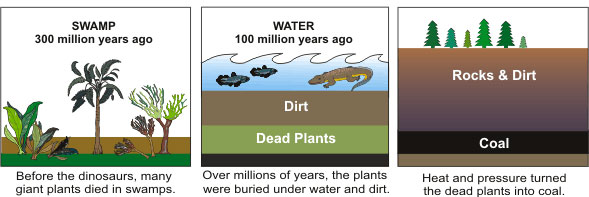
"Evolutionary theory" requires millions of years in the formation of coal in order to afford time for the development of living organisms whose fossils are found in coal deposits, fossils that they say were trapped in the deposits when they died. 
However, laboratory and field research has demonstrated that coal is formed rapidly and in vast quantities in every instance.

These vast coal deposits have no pollution by other material, they are pure coal so there is no reason to think the deposits are tampered with at all.

The conclusion is then naturally drawn from this that if the deposits are young then the earth around it must be young as well.

The actual research does indicate a young age to the Earth that contains such coalified materials.

They say the question arises then that:

"If {But It doesn't} coal takes millions and millions of years of heat and pressure to form, how is it possible that creationists are teaching that the earth is only a few thousand years old?"
This is a commonly asked question among individuals seeking answers about the age of the earth and the universe.
Research has been done by several creation organizations, as well as independent scientists, in order to answer such questions.

The evidence actually shows conclusively that coal does not take millions of years to form, as is commonly asserted. 
In fact, the formation of coal has been proven to be a rapid process that can be duplicated in modern laboratories in a matter of days - or even hours.
 
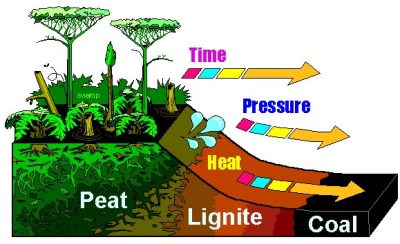
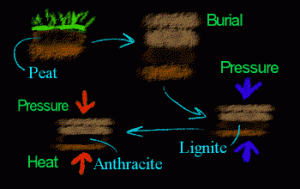
In order for coal to be formed, several factors must be present.
Pressure,
temperature,
water,
time,
and some sort of vegetation
are the key elements for the formation of coal.
According to evolutionary theory, the slow accumulation and decomposition of vegetation living in past ages accounts for the coal seams. However, this theory can not answer why such large amounts of original vegetation without soil can be found in the areas that are now coal seams, or how these coal seams became so thick - some being over two hundred feet in-depth.

I. Rapid Formation

Scientist Robert Gentry analyzed coalified wood found on the Colorado Plateau in order to determine how long it took for

 
coal to form.1 

By treating coal with epoxy and slicing it into thin sheets, Dr. Gentry was able to examine tiny, compressed radiohalos found in the coal. Radiohalos are discolorations in the coal, ejected by radioactive elements in the centers (such as uranium).
According to evolutionary theory, in order for these halos to form, several processes must have occurred. First, water-saturated logs must have been laid down in several different geologic formations, including the Triassic, Jurassic and Eocene layers. 

Later, uranium solutions infiltrated the water-saturated logs, and uranium decay products were collected at tiny sites within the logs.

The radioactive decay from the tiny particles ejected spherical radiation damage regions around those sites, thus producing halos. Finally, a pressure event on the site of the formations compressed the logs as well as the radioactive halos within them. 

However, because coal is not a malleable substance, scientists know that these logs had not turned to coal at the time the compression event occurred. This points to a quick burial and coalification of the logs – rather than a long time period.2

II. Decay Ratios

When the ratio of uranium decay to its decay product (lead) is analyzed, the conclusion is drawn that all the logs within the various geologic formations were buried at the same time. The high lead-to-uranium ratios admit the possibility that both the initial uranium infiltration and the coalification could possibly have occurred within the past several thousand years.3

III. Polystrate Fossils

The presence of "polystrate" trees (trees petrified or coalified in an upright position) point to a rapid coalification process. One of the most commonly known polystrate trees is found at Katherine Hill Bay, Australia. This fossilized tree can be seen extending over twelve feet, through several sedimentary layers.

According to evolutionary theory the different sedimentary layers took hundreds of thousands of years to accumulate.

However, we know this is impossible since the tree would have decomposed long before the sediments would have had time to accumulate.

Rather, this tree is testimony to the catastrophic and rapid burial that must have taken place.

IV. Unsullied Deposits

Finally, coal seams such as those found in the Powder River Basin of Gillette, Wyoming, ranging from 150 to 200 feet in-depth, point to a rapid coalification process.
"These coal seams run remarkably thick and unsullied by other material. Usually, unwanted sediments, such as clay, washes over a deposit before coal seams can get very thick.

This leaves scientists with the baffling question of how the seams get so massive and still remain undiluted by influxes of clay and other impurities before they thicken."4

1Robert V. Gentry, Video: Young Age of the Earth
2Ibid.
3Science , October 15, 1996
4Earth Magazine, May 1993
5Genesis, chapter seven


O.K. so we've learned that a young Earth is more than probable its likely as PROVED by Coal deposits and the untrue statements of Evolutionary science.


Watch (Click the Link) the complete video below to find out some amazing facts concerning the problems of Evolutionary Theories of men vs. The Creative acts of God!

http://www.christiananswers.net/creation/aqoo/home.html


The deluded, ignorant followers of Darwin believe that man is actually a type of animal. I disprove this godless blasphemy with totally real facts.


Creation vs Evolution Origin of Life (7 articles) When, why, and how did life begin?

Was it a meaning-less accident, or do we live within a God-created universe?

"Speak to the earth, and she shall teach thee."

What exactly does the earth tell us about its history?

What does the Bible say about earth's history? Does carbon dating prove the Earth is millions of years old?


Now lets look at the TRUE facts concerning Micro and Macro evolution and just what the real science states!
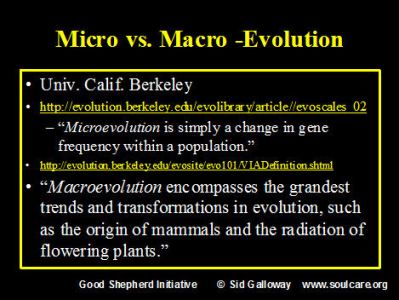

Micro and Macro-Evolution Explained

The difference between micro and macro-evolution is a major point of confusion between the Christian worldview and the Darwinian evolution worldview in today’s culture. Micro-evolution is the adaptations and changes within a species while macro-evolution is the addition of new traits or a transition to a new species. Micro-evolution is a fact that is plainly observable throughout nature.

Macro-evolution is a theory that has never been observed in science.

Evolutionist usually argue that those who believe in creation are ignoring the facts, however, there is nothing that evolutionist observe in science that creationist or Christians as a whole disagree with.

The point of contention is not on what is observed, but the belief systems that interpret what is being observed. Nothing in the Bible contradicts science; it is the assumptions that evolutionists insert into their world view that contradict the Bible.

Evolution is a hypothesis introduced as a possible explanation of origins, let us not loose sight of this FACT.

In this article, my goal is to explain the difference between micro and macro-evolution and show why micro-evolution cannot result in macro-evolution.

Micro-evolution is a fact.

This has never been disputed by anyone who understands what micro-evolution is.

Micro-evolution is the alteration of a specific trait due to natural response.
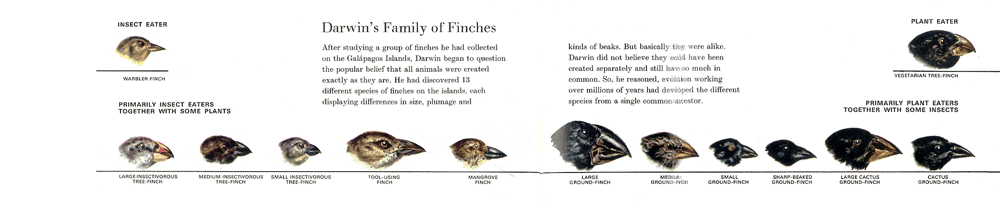
Take a look at Darwin’s observation of the changes in finches.

Isolated in the Galapagos Island, Darwin discovered finches that had much longer beaks than those found off the island.

His assumption was that evolution was changing this species.

However, these finches remained finches.

Princeton professor Peter Grant completed an 18 year study of the finches on this island. He concluded that during drought years, the finches with shorter beaks died off because with a limited supply of seeds, only those that could reach the grubs living under tree bark could survive.
With limited resources on a small island, these finches could not migrate to find food.

We clearly observe natural selection, but not macro-evolution.

However, it is not a permanent change.
The finch offspring with shorter beaks prospered during seasons of plenty.
Natural adaptation is the function of micro-evolution.

There are three plainly observable principles to micro-evolution.

1. A trait will alter because of a stimulus.
2. The trait will return to the norm if left to nature or returned to its original conditions.
3. No new information is added to the DNA.
The argument for evolution is that species will change slightly over time and eventually change into something completely different and will over eons of time eventually become a new species.

This theory was thought up as a hypothesis and as science advances, the facts have not been found to support it, but much has been provided to dispute it.

There are no examples in nature that even remotely indicates a change of species through evolution. The fossil records have zero transitional forms.
Even fossilized insects such as spiders and ants that have been dated to pre-historic times are identical to modern day spiders and ants.

There are three critical flaws in the theory of evolution through gradual change:

Dysfunctional change,
the DNA code barrier,
and natural selection removes DNA information but does not add new information.


1. Dysfunctional change or otherwise noted as irreducibly complex.

When a trait is critical for the survival of the species, it must be fully functional or the species will die off and any ‘evolutionary progress’ would be lost. For example, a bat could not evolve from a rodent because it is completely dependent on its wings for survival.
A half-evolved wing could not be used for walking because of its awkward length and shape and would not be functional for flying.
The idea of a half-evolved bat is completely illogical.
It would be easily tracked down by predators and it would be helpless to get food and survive on its own.

This need for completeness can be clearly observed from the most primitive single celled animal to the most complex mammal.

To contradict this idea would clearly contradict Darwin’s principle of natural selection.
Many scientists are making a shift because gradual change produces dysfunction in-between species. The new emerging proposal is the quantum jump. Jay Gould proposed the idea that every living cell could possibly be encoded with the ability to change into any other living thing. He believes that an external stimulus causes this jump.
This is a bigger stretch than gradual evolution. Based on his idea, simple pond microbes would have the same DNA encoding as humans and science has proven that this is not the case. Primitive life forms have far less genetic material than more complex animals such as a mammal.
Gould’s leap of faith also does not account for varieties of different species. If environment is the trigger and we all have the same DNA, the jump should be to the same creature. Plus we can plainly observe that this reaction does not occur today. Moving from a warm weather climate to a cold weather climate doesn’t trigger a different type of offspring.

2. The DNA code barrier.

A fact of genetics is that trait changes have a ceiling.
This perhaps is the biggest obstacle to gradual change through micro-evolution.
Each rung of DNA is made up of four chemicals called nucleotides, designated by the symbols:
A (adenine),
G (guanine),
C (cytosine),
and T (thymine).
These rungs of DNA are combined to provide a blueprint of the traits that organism will have. If you took all the DNA in the human body and put it in written format, it would fill up one million volumes the size of a 500 page encyclopedia.
With all this genetic data, if two people could have as many children as there are atoms in the universe, no two children would be identical. Though there are a limitless combinations of traits that we possess, there is a limit to how far each trait can change. There is a limit to the number of combinations of these chemicals; therefore there are a limited number of trait variations. No new genetic material can be added.
Trait changes result in re-arranging the genetic code that is already present.

Mixing the available genetic code will produce variations in the trait but will not change into a completely different feature.

For example, your parents genes are combined to produce your various traits. People have several different colors of hair, eyes, and skin, but without a mutation, these traits will remain within its boundaries.
There are mutations that can occur and mutations almost always cause diseases or defects. However, even under mutation, skin will still be skin and eyes will still be eyes. Because of the code barrier, there are a limited number of variations in eye color. Different genes can create distinct variations but there is a limit. There can be rapid changes but inevitably, there is a return to the norm.
Charles Colson made mention of a few good examples of this principle. Darwin used breeding of the rock pigeon as a basis for his theory that gradual changes in species will evolve into new species.
All pigeons are descendents of the rock pigeon. This pigeon is the same pigeon that can be found in most city parks. Through selective breeding, Darwin was able to produce many drastic variations of pigeons.
He observed very rapid changes in traits that he could alter by this selective breeding and concluded that if he could make these changes within a few generations of pigeons, in time a new species of bird would develop. 

The Origin of Species--Creationism and Evolution 

There are several flaws with this theory.

1. His intervention was the trigger for these various breeds. It did not occur naturally.
2. When left alone, his pigeons returned back to the ancestral rock pigeon within a few generations. If his theory were valid, they should have continued their ascent.
3. Darwin never lived to see that there was a natural barrier that slowed changes after a few generations and eventually reached a stopping point.

Change can be rapid when leaving the ‘norm’, but slows and eventually stops as the ‘ceiling’ is reached.

There is a limit to the number of combinations a specific trait can have.
Another good example of this comes from the book,
‘How Now Shall We Live’.
150 years ago, sugar cane farmers committed to increasing the sugar content in their sugar beets. At the time the project began, sugar content was at 6%. Through selective cross-pollination, within a few generations of beets the sugar content soared to 13%.
Over the next 75 years these growers were able to inch the sugar content up to 17%. Now, 75 years after they were able to achieve the 17% barrier, the sugar beet remains at 17%.
This is a clear example of the DNA code barrier that limits the variation of a specific trait. This example shows the same principle that Darwin unknowingly discovered. Rapid change, then slow change followed by no change.
Another conflict with the evolutionary theory is that when the DNA ceiling is reached, the species becomes weak.
When a trait is exaggerated beyond its natural limits, the species weakens and suffers from genetically induced diseases or vulnerability to disease.
The farther from the ‘norm’ the more disease prone the plant or animal becomes.
So even with selective breeding and exploited traits, the species becomes vulnerable and at risk of extinction. Animals that are bred to bring out their desired features often become sterile or diseased.
We can look around today and see examples of this problem. Anyone involved with farming is aware of the sterility problem associated with over-breeding. Dogs are very defect prone when they are bred to show quality. However, when left alone, species will soon return to the norm.
Natural selection thins the gene pool, but evolution demands that information be added.
No evolutionary change (i.e. micro evolution) ever adds information to the genetic material.

The only way evolution (i.e. Macro evolution) could be possible is if new information were to be added to the DNA.

Hybrids are often used as examples of how simple it is for evolution to change the DNA of plants or animals. You can cross-pollinate two types of tomato plants to produce a new tomato plant that produces larger fruit. There are three problems with how evolutionists interpret this observation.
The first problem is the most obvious; nature is not making a change, human intelligence is forcing the change and must prevent nature from reverting back. Second, the next generation of seeds is both sterile and unable to reproduce, or it reverts back to an inferior fruit.
The third problem is that you are not taking on new information; you are combining two plants that already possess the necessary information and have compatible DNA structures. 

Introduction to Scientific Creationism 

For evolution to be possible, there must be new information added that did not previously exist.

In other words, information must come into the existing genetic material without any pre-arranged order, combine with the DNA that is already present and create a new or better code than that which already existed. If newly added information is garbled, the DNA that existed would be useless.
If it was inserted in the wrong place or in the wrong order, the plant or animal produced would die or be completely dysfunctional. For example, a microbe would need to somehow acquire enough information through millions of error-less mutations that added to its DNA, which would enable it to become a fish.
A fish would have to get the new information that did not previously exist to form a lung, then feet, feathers and so on.
The problem is that science does not observe mutations that add to the information, but rather just the opposite. It is a loss of information that occurs when mutations occur. Natural selection is a good example of this.

Survival of the fittest is what thins out the gene pool; it does not increase or add to the genetic data.

Natural selection does open the door for adaptation and changes within a species, but it accomplishes just the opposite of what is necessary for evolution. When natural selection occurs, the species that have certain traits are often weeded out.


If Darwin had been correct in his observation and the Galapagos Island finches permanently weeded out the shorter beaked finches, they have not added to the gene pool, but they have subtracted genetic code and would no longer have the information necessary to produce offspring that has a shorter beak.

Natural selection and evolution work against each other.

Natural selection does sometimes make changes within a species, but the progression is downward and not upward – and the species does not become a new species, but rather a variation of the old.

A permanent change is a loss of information, but evolution requires the addition of new information.
In science we can clearly observe that when species have a trait that the environment challenges, those who have this trait are weeded out.
What has never been observed in science is the addition of new information. Even if an example should be found to have happened by chance, it doesn't help the evolution cause. There must be millions of changes that add to the DNA information, without harming the species.

We don't observe this happening.

We do observe mutations, but they are a loss of information or a defective copy of information that damages the species.


Richard Dawkins is arguably the most influential proponent of evolution today.

In a debate, he was asked to provide one example where new information was added to DNA as observed by science.

After a long silence, he passed by the question.

He later rebutted the question with a three page argument but never addressed this original question and he did not provide one example.

This is exactly what I was saying on my other page that skeptics do: Avoid the original question because your proof is non-existent and answer with another issue unrelated to the original problem!

Even environmental adaptations harm the evolution belief system.

When the environment changes and those animals that have traits that prevent them from surviving, there is not an increase of information, but a loss of genetic code.
Even microscopic evolution shows this problem.
We have all heard about the ‘super germs’ that have grown resistant to antibiotics.


In reality, they are weak germs.

Bacteria that is resistant to drugs are usually destroyed by other organisms.
For example, bacterium that has mutated so that it no longer pipes in the toxins that would normally destroy it are weaker than other bacteria because they also cannot pipe in the nutrients that are needed to flourish.
It may fail to produce enzymes that enable it to resist the drugs, but this also becomes a crippling factor that limits its survival. The very mutations that make it resistant also make it vulnerable and weak.
These issues render change by micro-evolution impossible thus leaving macro-evolution as the only stand that evolutionists can take, and all the evidence clearly disputes the concept of macro-evolution. The fossil records show zero gradual change. Species in existence today show no change from the fossils that supposedly date back hundreds of millions of years.

Interdependency also renders evolution an impossibility.

Nature is filled with species that are completely dependent on other species.
If one species cannot survive without another, evolution becomes an illogical deduction. There are also interdependencies between plants and animals.

 

If a plant is dependent on an animal and an animal is dependent on that specific plant, the two would have to emerge from the evolutionary change at the exact same time and place.

One generation later is too late.

This cannot be overcome.

Don’t mistake micro-evolution for Darwinian evolution.

They are not related.

When a Christian says they do not believe in evolution, it is not a reference to changes in specific traits. It is a reference to changes that require crossing the DNA limitations.

When the facts stare evolutionists in the face, they are reduced to either insulting those who present the evidence or they must admit their world view doesn’t hold water.

Evolutionists always call Christians and creationists non-thinkers because we question the illogical theories they believe, but that's just what a true THINKER does...questions theory so it can be brought into the realm of fact.

Critical analysis is not un-intellectual, but it is unreasonable to refuse to honestly look at the whole picture painted when all the facts are presented.
When someone builds their belief system around a godless world view, it leaves the realm of science and becomes a religious defense.

Anyone who gets angry at the facts is not defending science, but is defending their hope that God does not exist and their hope that there is no God in which we are accountable.

Eddie Snipes
Exchanged Life Outreach
http://www.exchangedlife.com

Major Problems with Theory of Evolution


“recognizing a new species during a formative stage can be difficult, because biologists sometimes disagree about how best to define a species”.

(John Rennie, Scientific American, “15 Answers to Creationist Nonsense”. June 2002)

Wow!!! Do evolutionists have the nerve to accuse creationists of not having perfect knowledge of what a "Kind" is?
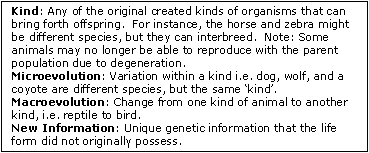


This is an important point for evolutionists to keep in mind when creationists don't have a perfect definition of what a kind is.

Creationists, however, do have a good idea of what a kind is.

The Bible makes it clear that if two different organisms can bring forth offspring, then they are the same "kind" of creature.

The break down happens because today some animals that are of the same "kind" may no longer be able to reproduce with the parent populations because of loss of information or ability.


THE METAMORPHOSIS OF A COMMON FROG IS EVOLUTION, MICRO-EVOLUTION THAT IS.

THIS TRANSFORMATION IS PRE-PROGRAMMED, BY A PROGRAMER, INTO THEIR GENETIC CODE.

CREATIONISTS AND EVOLUTIONISTS BOTH ACCEPT THIS FACT.

WHERE THEY DIFFER IS WHO OR WHAT THE PROGRAMMER WAS.


NOW PICTURE THIS FROG AS BEING AN EXTINCT UNKNOWN SPECIES.

NOW PICTURE ALL THESE FORMS BEING FOUND, IN SEQUENCE OF LOWER LEFT FIRST TO LOWER RIGHT LAST, OVER AN "UNKNOWN" PERIOD OF TIME IN THE GREEN RIVER FORMATION OF WYOMING.

KEEP IN MIND, WE HAVE NO PRIOR KNOWLEDGE OF THESE CREATURES.

HOW ARE FOSSILS TO BE INTERPRETED BY CREATIONISTS AND EVOLUTIONISTS?

1.) EVOLUTIONISTS WOULD LABEL EACH FOSSIL AS A DISTINCTLY SEPARATE SPECIES.

2.) THEN THEY WOULD PROCLAIM THESE FOSSILS WERE BURIED OVER LONG PERIODS OF TIME AND ARE "PROOF" THAT THEIR MACRO-EVOLUTIONARY THEORY IS TRUE!

CREATIONISTS, ON THE OTHER HAND, WOULD PROCLAIM THESE FOSSILS AS "PROOF" OF CATASTROPHIC, RAPID BURIAL OF A RELATED SPECIES.

THE SMALLER, LESS MOBILE CREATURE BEING BURIED FIRST WHILE THE LARGER, MORE MOBILE BEING ABLE TO SURVIVE LONGER BEFORE FINALLY BEING BURIED, COMMON SENSE LOGIC AS OPPOSED TO MAKING UP TIMEFRAMES THERE'S NO PROOF FOR.

The LIFE NATURE LIBRARY & Smithsonian Books

Falsely Portray "Micro-Evolution" as the Basis of Faith in Macro-Evolution


For years these "Mickey Mouse" examples, of genetic variation and human manipulation, have been used by the meta-physical scientific community to imply that macro-evolution, an unobserved metaphysical theory, is therefore true.

Talk about a magic act, pulling "Bull" out of thin air!

Some scientists admit the fallacy of this non-empirical assumption.

R.B. Goldschmidt, American Scientist 40:84 (1952)

"It is true that nobody thus far has produced a new species of genus, etc. by macro-mutation. It is equally true that nobody has produced even a species by the selection of micro-mutations.

Because small changes (micro-evolution) can be observed or produced in roses, dogs, fruit flies and Mickey Mouse cartoons, in no way verifies macro-evolution than the "biogenetic law" of embryological recapitulation, a fraudulant theory, was claimed to do in the past."

—W.R. Bird, Origin of the Species Revisited, Vol. 1, pp. 196-197.

"Raup and Stanley call the biogenetic law `largely in error'; Ehrlich and Holm note its `shortcomings' and its place in `biological mythology'; Danson says that it is `intellectually barren'; de Beer refers to the `evidence against the "biogenetic law" of recapitulation in Haeckel's sense'; Encyclopedia Britannica calls it `in error'; and even Mayr of Harvard describes the biogenetic law as `invalid.'

In fact, Haeckel, the formulator of the "biogenetic law,' supported it with `faked' drawings."


March 4, 2008

How Old is the Universe? It may suprise you!


Lambert Dolphin
lambert@ldolphin.org

Library

Originated, June 29, 1998. Revised March 14, 2003, November 7, 2003.


"I have enjoyed participating for some time in an Internet creation discussion group whose membership is limited to those who believe the universe is of recent origin.  

One of our members, a capable professor of physics, has openly stated that scientific evidence presented by creationists for a young earth is scanty and not very convincing at the present time. I had to agree with him almost line for line.

 
My own belief in a recent creation is a result of my Christian world-view and this in turn stands on my experience in a personal relationship with Jesus Christ over 35 years (almost half my life), plus my confidence in the integrity and accuracy of Scripture. When I first became a Christian I soon saw the New Testament promises for peace, hope, guidance--and power to overcome personal evil--were all demonstrably true in my own life.


One day I went to visit the pastor who had led me to the Lord. I had with me some exciting new scientific news that seemed to conflict with the Bible. To my surprise my pastor friend was not very interested. Instead he said something like, "Son you have seen that the truth of the New Testament can be experienced by faith. The whole Bible is the Word of God. Jesus lived by it, the apostles took it to be authoritative and accurate, you would do well to do the same."


Though my scientific pride was wounded that day I took my mentor's advice seriously and soon began to see that Old Testament is also true and accurate and will yield life-changing power and God-given insights when it is received by faith and acted upon in trust, (i.e., on the basis of faith plus obedience).

The simple discovery I had made some months earlier--namely that Jesus Christ was alive today and that He could be communicated with one-on-one--was radical for me. It worked! But rather than simplifying for me the issues of science and the Bible my new-found faith only raised for me the possibility that considerable tension might actually exist between man's current secular scientific conclusions and something more eternal and unchanging found in the Bible. 


Gradually over the years I tried to build an overall world-view beginning with Creation and explaining man's plight and destiny and God's work in history. Along with this growing knowledge of the simple historical narrative in Scripture it seemed to me more and more clear that the universe was surely of recent origin. 


For instance, Adam and Jesus Christ are connected by a genealogy which has few if any gaps and this places Adam's time as being clearly not many thousands of years ago. Did it make sense to have an empty universe for billions of years with man arriving on the scene only very very recently?

Yet the Bible links the very existence of the universe to man's presence and his exalted position as the original steward and manager over God's household. If Adam were recent, why not the rest of all that God had created as well? See Arthur Custance's work on this, The Genealogies of the Bible: A Neglected Study.


I saw that population growth is always very rapid---evolutionary time scales are absurd for generating the present population in time periods greater than a few thousand years. The present world population can easily have been generated in thousands--not millions of years. As I looked at recorded history, especially archaeological evidence, I saw that evidences about man and civilization extend thousands or at most ten thousands of year into the past, not longer. There may be older fossils of individual men or apes, but no ruined cities, no relics, no written records. 


Ian Taylor's book, In the Minds of Men: Darwin and the New World Order helped me to see how the old paradigm of a young earth gave way to modern ideas of an old universe in the early 1800's--but not for really sound scientific reasons. Instead these changes were matters of philosophy and presupposition. All science rests on such presuppositions. I was fortunate to have been invited to Canada, not once by several times, where I met and traveled with and worked with Ian Taylor. His scholarship is impeccable and he is well-read and well-informed. We became good friends.

I began to see that all science grows in the environment of an underlying philosophy. All theories begin with presuppositions. All mathematical models start with initial conditions and assumptions. I saw also that science is limited in scope to physical observables. Many intangibles in life I was aware of--mind, conscience, love, the soul, creativity, beauty, religious experience were real but not easily described and certainly not explained by science.

As I came to know the Bible better I saw that Biblical revelation is additional information given to us from outside the system of the universe--data that comes to us from beyond time and space. Information contained in God's revelation to man is not data one can arrive at by scientific research,, by experience, or by intuition. Truth from revelation can be confirmed in individual experience to that individual's satisfaction even if it can not be established in a scientific court of inquiry. 


I do believe it is important for me (and for everyone else, too) to form a self-consistent world view. My ultimate confidence is in the revelation of the Creator of everything to His creatures. My conclusions might leave me in the end keeping company with a very small number of fellow-travelers, but "Let God be true though every man be false, as it is written." (Romans 3:4)


On the other hand I believe evidence from science must ultimately agree with Biblical revelation. Otherwise I am an ostrich with his head in the sand and will in the end not have correctly interpreted the Bible. Down through history segments of the church have been greatly embarrassed because they shut themselves off from the outside world and stuck to their own rigid opinions about what the Bible did and did not say. 


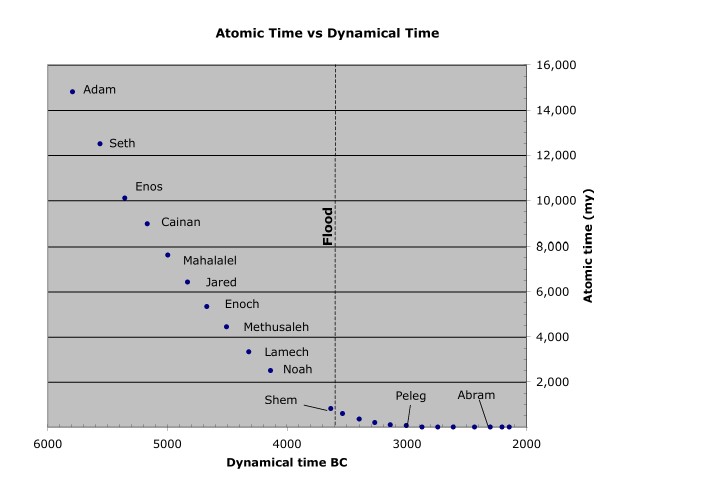
For many years I have followed, and worked closely with, Australian astronomer Barry Setterfield. Barry's main focus has been to show that the speed of light (c) is not a fixed constant over time but has dropped since creation. My colleague Canadian Statistician Alan Montgomery and I have worked together on the available measurements of various atomic constants. 

Alan and I and confirmed in published papers that the speed of light has dropped in the last 300 years. A decreasing speed of light would mean that the radiometric (atomic) clock has slowed down with respect to dynamical time by a factor of 10 or 11 orders of magnitude. 

See the Barry Setterfield Research Library for full details. Barry's recent work would indicate that Adam lived about 6000 BC and the Flood of Noah occurred about 3500 BC.
Most creation scientists believe there is indeed an appearance of age in the universe. For instance when we first meet newly-created Adam in the Garden of Eden it is generally assumed he was a fully grown man, that he had no navel, and the trees of the Garden were mature trees and not mere sprouts. There are corresponding atomic and dynamic time scales for the standard geological column.

 
The Masoretic Hebrew text (MT) of the Bible taken literally leads to a creation date of about 4004 BC. This has always seemed to me to be too recent. The Septuagint (LXX) translation ages and time spans give a creation date closer to 6000 BC. The LXX is used by Setterfield in his Creation and Catastrophe Chronology. Bible scholar Bernard Northrup likewise places confidence in LXX dates over the MT. See The Genesis of Geology, by Bernard Northrup, ThD. Curt Sewell presents a very helpful comparison of Old Testament dates, Biblical Chronology and Dating of the Early Bible. There are many problems in reconciling OT chronologies! Glenn Miller of the Christian Think Tank comments: 

1. I know very little about number things in the OT, and what I do know is decreasing (e.g., I am losing confidence that all/many/most of them were MEANT by the author to be taken as real 'numbers'...some cases seem to be obvious symbolic values, semi-puns, pedagogical devices, memory aids, etc.).
 
2. Genealogies are especially problematic, IMO, since the numbers in them had ZERO importance to their social function (i.e., to situate an individual in an social context)--numbers meant/contributed NOTHING to this task, and are accordingly 'window dressing' and/or a way to indicate SOME THING ELSE. What this 'something else' is, in an ancient context, both variable and unclear to me.

3. The LXX "bails us out" several times in OT numerical problems/contradictions, so, as a source it has a high--but uneven--credibility with me for such things.

4. I haven't studied this, but if I had to, the approach I would START WITH would be to build a comparative table of four (maybe five or six) columns, with one row for each number in Gen 1-11 (not just genealogy numbers--patterns in other numbers might reveal some pattern of number 'meaning' or literary usage).

The rows would consist of the numbers in the different versions:

(1) The MT (obviously, but you would need to check the Text Apparatus for juicy variants),

(2) The LXX (obviously),

(3) The Dead Sea Scrolls (representing our OLDEST real mss of the Hebrew bible, of course. I would start with the work by Abegg, Flint, Ulrich --"The Dead Sea Scrolls Bible", and if one of the numbers they give look juicy, you could drill down);

(4) the Peshitta (of possible value),

(5) the Targums (late, but still BEFORE the MT in many cases); and

(6) parallels from the OT Pseudepigrapha and Apoc.: the category/genre known as "Retold Bible" are paraphrases/expansions of the early narratives (esp. Patriarchal), so you might find some interesting stuff in there. Since many/most of these are pre-MT (and some anti-MT...smile), they might could be of importance to your quest. [You could also check the rabbinics--Ginzberg's Legends of the Jews probably has all the alternate dates/ages/lengths listed in his work...there might be some variants in there.]

That's all I can suggest, since the next step would depend upon what patterns were detectable in the columns, of course...but it would be a fascinating subject!
I certainly can not prove to anyone that the universe is young. Had I lived in the 18th Century I believe most everyone around me (in the Western world) would readily agree with my young-earth hypothesis. It was taken for granted back then and seldom challenged.
Regarding the true age of things, I believe Scripture suggests this may be one of the areas where we may never really know for sure. Ecclesiastes 3:11 says this,
"...[God] has put eternity into the hearts of men, yet so that no man can find out what God has done from the beginning to the end."
I take this to suggest that the past is obscured in mists and uncertainty--as is the future--so we can not resolve with certainty the true age of things nor the detailed history of the universe. If we could time travel from the present into the past we would encounter several discontinuities where God has interfered with the status quo and altered man's future course and destiny. The passage in Ecclesiastes is similar to the New Testament claim that we can not set dates for future dates which are predicted to occur.
"So when they [the disciples] had come together, they asked him, 'Lord, will you at this time restore the kingdom to Israel?' Jesus said to them, 'It is not for you to know times (chronos) or seasons (kairos) which the Father has fixed by his own authority.'" (Acts 1:6-7)
The Bible is clear in telling us that the actual history of the universe has not been "uniformitarian." (2 Peter 3:3ff)
First of all you must understand this, that scoffers will come in the last days with scoffing, following their own passions and saying, "Where is the promise of his coming? Forever since the fathers fell asleep, all things have continued as they were from the beginning of creation." They deliberately ignore this fact, that by the word of God heavens existed long ago, and an earth formed out of water and by means of water, through which the world that then existed was deluged with water and perished. But by the same word the heavens and earth that now exist have been stored up for fire, being kept until the day of judgment and destruction of ungodly men. But do not ignore this one fact, beloved, that with the Lord one day is as a thousand years, and a thousand years as one day.

The Lord is not slow about his promise as some count slowness, but is forbearing toward you, not wishing that any should perish, but that all should reach repentance. But the day of the Lord will come like a thief, and then the heavens will pass away with a loud noise, and the elements will be dissolved with fire, and the earth and the works that are upon it will be burned up. Since all these things are thus to be dissolved, what sort of persons ought you to be in lives of holiness and godliness, waiting for and hastening the coming of the day of God, because of which the heavens will be kindled and dissolved, and the elements will melt with fire! But according to his promise we wait for new heavens and a new earth in which righteousness dwells.

Therefore, beloved, since you wait for these, be zealous to be found by him without spot or blemish, and at peace. And count the forbearance of our Lord as salvation. So also our beloved brother Paul wrote to you according to the wisdom given him, speaking of this as he does in all his letters. There are some things in them hard to understand, which the ignorant and unstable twist to their own destruction, as they do the other scriptures.

You therefore, beloved, knowing this beforehand, beware lest you be carried away with the error of lawless men and lose your own stability. But grow in the grace and knowledge of our Lord and Savior Jesus Christ. To him be the glory both now and to the day of eternity. Amen.
I was not present at the time of creation, none of my friends were. The scientific theories I have studied regarding the origin of the universe are surely only crude models. And they are built on the dubious assumptions that one can take 50 or 100 years of observations, compile the data and draw a curve extending backwards in time to t = 0. The Bible teaches me to be highly suspicious of any such simplistic models. 

The Apostle Peter's warning seems quite clear to me in this regard.


Though I personally assume the universe is young, and though I naturally look for evidence that this is really so, the age of the universe is not a major plank in my platform of beliefs.
I know that the gospel is primarily an appeal to the conscience. Knowing God is a moral issue above all else (and all men are without excuse). Apologetics, such as we Christians try to do, should indeed be done with the highest possible integrity and openness. We Christians represent the Most High God by all we do and say and are. The fact that God has chosen the foolish things of this world to confound the wise does not give us the right to be stupid and ill-informed, not doing our homework, nor ignoring our critics. 

If individuals can be deceived and misled in this world--and I was once a prime example--then I have no problem with groups of well-intentioned scientists being wrong sometimes, or even often. I have lived long enough to have seen all sorts of once-popular scientific ideas give way to the newer and better. 

The statement "It is the glory of God to conceal things, the glory of kings is to search them out" tells me God values and rewards our search and discovery processes. Our hard questions are welcome in His courts.
Astronomer Allan Sandage said this, "Science is the only self-correcting human institution, but it is also a process that progresses only by showing itself to be wrong."


Comments on the Age of the Universe, (from a colleague) 

Question:

Doesn't scientific evidence show that the earth is much more than only 6000 years old?
Answer:

There is no scientific measurement of the earth's age whatsoever. That is because there was no clock starting at the beginning and continuing to the present. Instead, dating consists of "extrapolating" present-day processes of various sorts back into time assuming the processes have not changed in rate. But there is abundant evidence of changes in rate of radioactive decay and other processes (e.g., radiohalos).

The current estimates of about 4.7 billion years for the age of the earth were not arrived at by objective research with no thought of Darwinian evolution. They were found by predetermined notions that the age should be in the billions of years in order to allow sufficient time for evolution--in other words "objective" radiometric dating was designed specifically to help Darwin's theory.

A government scientist rejected scientific creationism and a young earth model with the following comments: So why does science now believe the age of the universe to be much older than some Christians propose? It is because the evidence overwhelmingly demands it. 'tis not something someone dreamed up and then looked for the evidence to support it.'

But that is exactly what evolutionists did in the late 19th century: They deliberately 'dreamed up' the idea that the earth must be from hundreds of millions to billions of years old and then went in search of evidence to support it.

Charles Darwin decided in the first edition of Origin of Species that he needed 'far longer' than 300,000,000 years of earth history in the Cenozoic era alone for his theory of evolution to work though he never explained why evolution needed that specific amount of time (and even today no more than about 65 million years is allowed for the Cenozoic era) - so there's your 'something someone dreamed up.' Lord Kelvin initially gave him less than a hundred million years, but his later estimates dropped still further and allied calculations such as Peter Tait's came down as low as several million years, thus creating what has sometimes been called Darwin's greatest crisis. 

Darwin struggled for decades (from Kelvin's first direct challenge in 1865 until Darwin's death in 1882) trying to get around this problem. Darwin and his supporters enlisted help from every quarter - geologists, physicists, biologists, engineers, mathematicians, etc. - to try to refute Kelvin. It even made 'bulldog' Thomas Huxley, Darwin's staunchest defender, 'squirm,' says renowned evolution historian Loren Eiseley.

Loren Eiseley, Darwin's Century (Anchor Books/Doubleday, Garden City, N.Y., 1961 [1958]) pp. 233-253, esp. p. 237 quoting Charles Darwin, The Origin of Species (John Murray, London, 1859 [Philosophical Library, New York, 1951 reprint] p. 245. Eiseley wrote that there had been few if any scientific attempts to date the earth prior to Kelvin and that until then geologic time was considered vague and 'unlimited,' thus allowing whatever Darwin needed for his theory:

'...within six years after the [1859] publication of that work [The Origin of Species] an attack on the conception of unlimited geological time had been launched with such vigor that, by the end of the century, it was still one of two leading arguments entertained by many naturalists as casting doubt upon the principle of natural selection.

It had SHAKEN THE CONFIDENCE OF DARWIN himself, forced Huxley into a defense characterized more by SOPHISTRY than scientific objectivity, and placed geology in general in the position of an errant schoolboy before his masters. The attack had been launched by Lord Kelvin, contended by many historians of science to be the outstanding physicist of the nineteenth century...'It can be observed from Darwin's letters that this development in physics gravely troubled him.

He refers to Lord Kelvin as an 'odious spectre,' and in a letter [of 1869] ...he writes: 'Notwithstanding your excellent remarks on the work which can be effected within a million years, I am GREATLY TROUBLED at the short duration of the world according to Sir W. Thomson [Lord Kelvin] for I require for my theoretical views a very long period before the Cambrian formation.' ...Painfully and doubtfully he [Darwin] wrote to Wallace in 1871, 'I have not as yet been able to digest the fundamental notion of the shortened age of the sun and earth.'(Eiseley, supra, pp. 234, 235, 240, my capitals added.)

Evolutionary geneticist Hugo De Vries wrote in Science in 1904 that Kelvin's age calculations 'threatened to impair the whole theory of descent' because gradual EVOLUTION REQUIRED 'many thousands of millions of years [= MANY BILLIONS OF YEARS].' (Science, N.S. 20:398, quoted in Eiseley, supra, p. 248.)

Science historian Albritton writes of some of the desperate efforts about 1865-1900 to get around Kelvin's limit. As Kelvin kept reducing his estimates the reactions of the scientific community 'ranged from meek accommodation to RESOLUTE OPPOSITION. Alternate SCHEMES of measuring time past were DEVISED, and the figures resulting from these EXERCISES IN ARITHMETIC ranged between 10 million and 15 trillion years.' (Claude C. Albritton, Jr., The Abyss of Time Freeman, Cooper & Co., San Francisco, 1980) p. 203, my capitals added.)


Why would there have been "RESOLUTE OPPOSITION" to simple reductions of a number, the number representing the age of the earth, if it was all merely an objective and dispassionate "search for the truth"? 

The reality was that scholars made every effort to try to give the evolutionists what they wanted in the way of large amounts of geologic time. This was favoritism and bias towards Darwin. As with Darwin and those evolutionists cited by De Vries, this typically amounted to the order of magnitude of BILLIONS OF YEARS.

One author estimated the age of the earth from sedimentation rates for geologic strata as somewhere between 10 million and 5 trillion years, with a rough logarithmic mean of 6 BILLION YEARS. (William J. McGee, Science (1893) 21:309-310, cited in Albritton, supra, pp. 192-193.)

Another author critiquing Kelvin's work said 'If PALEONTOLOGISTS have good reasons for demanding much greater times [than 400 million to 1 billion years] I see nothing from the physicists' point of view which denies them four times the greatest of these estimates' - in other words 4 BILLION YEARS. (John Perry, Nature (1895) 51:582-585 at p. 585, quoted in Albritton, supra, p. 195.)


Hence, there was a lot of effort in the 1865-1905 period to find evidence to support figures for the earth's age in the BILLION-YEAR range in order to aid the evolutionists' guesswork. Eiseley comments that 'A collected bibliography of the subject through the period 1862 to 1902 would be enormous.' Albritton remarks that these were not really scientifically sound estimates, 'Given the prevailing uncertainties ...one could arrive at almost any preconceived magnitude of time.' (Albritton, supra, pp. 186, 192, my capitals.)

These pioneer geochronologists knew approximately what time frame to expect in order to satisfy the evolutionists and not surprisingly they eventually found it. As early as 1878, a scheme was worked out in which the basic geologic time scale approximating our Paleozoic-Mesozoic-Cenozoic eras would occupy about 600 million years - exactly the modern day figure to one-digit precision but long before radioactivity had even been discovered. (T. Mellard Reade, 'Limestone as an Index of Geological Time,' Proceedings of the Royal Society (1878) 28:281.)


Some like to suggest that the scientists who developed radiometric dating had no idea they were going to find an Old Earth, that they had no interest in the evolution controversy, that they simply reported the facts as they found them, unaware of the implications until after making the discovery.

But history says differently. Once Curie and Laborde discovered in 1903 that radioactivity gave off heat, this immediately led Rutherford to suggest in 1904 that radioactivity could now refute Kelvin's overly restrictive age of the earth, which had been based on the projected cooling rate of the planet from a hot molten state. Rutherford wrote:


'...the temperature gradient observed in the earth may be due to the heat liberated by the radioactive matter...If this be the case...Lord Kelvin's computation may only supply the minimum limit to the age of this planet...The discovery of the RADIOACTIVE elements, which in their disintegration liberate enormous amounts of energy, thus increases the possible limit of the duration of life on this planet, and ALLOWS THE TIME CLAIMED by the geologist and biologist for the process of EVOLUTION.' (Ernest Rutherford, 'The Radiation and Emanation of Radium' part 2, Technics (August 1904) pp. 171-175, reprinted in The Collected Works of Lord Rutherford of Nelson (Allen & Unwin, London, 1962) vol. 1, p. 657, quoted in Albritton, supra, p. 203, my capitals added.)


Here we have a clear statement of interest by Rutherford in finding evidence to support the evolutionary time scale by use of radiometric dating -- at the very inception of the concept by its inventor, Rutherford. Shortly thereafter (1905), Bertram Boltwood and John Strutt (Lord Rayleigh) took up Rutherford's idea and made the first attempts to radiometrically date rock specimens. (Albritton, p. 204)


Question: Doesn't the fossil record indicate change over time? Why aren't there human fossils in all the strata?

Answer: The fossil record does NOT show the millions of fine intergradations between major categories of organisms that Darwin and his successors expected. That is why "punctuated equilibrium" theories were developed in recent decades to explain away the massive gaps in the fossil record.

Human fossils and manufactured artifacts ARE found in various geologic strata but they are relatively rare due to difficulty in finding them in the massive sediments constituting the "geologic record" since the Cambrian layer and due to the destructive effects of catastrophic sedimentation. (See Forbidden Archeology by Michael Cremo and Richard Thompson, a massively documented 1,000-page book researched by NON-Christian Hindus and devoted to compiling evidence of human remains and artifacts in geologic strata.)

It is also likely that humans were better able than animals to avoid sudden catastrophic burial in sediment by fleeing to higher ground. Also, there may have been localized less sediment burials with the world's human population concentrated mainly in the Middle East where flood conditions may have been less severe than elsewhere (as witness the survival of Noah's Ark)."

Lambert Dolphin
lambert@ldolphin.org

Library

Originated, June 29, 1998. Revised March 14, 2003, November 7, 2003.

Popular Posts

"Atheism turns out to be too simple. If the whole universe has no meaning, we should never have found out that it has no meaning. . ." – Mere Christianity