"I have enjoyed participating for some time in an Internet creation discussion group whose membership is limited to those who believe the universe is of recent origin.
One of our members, a capable professor of physics, has openly stated that scientific evidence presented by creationists for a young earth is scanty and not very convincing at the present time. I had to agree with him almost line for line.
My own belief in a recent creation is a result of my Christian world-view and this in turn stands on my experience in a personal relationship with Jesus Christ over 35 years (almost half my life), plus my confidence in the integrity and accuracy of Scripture. When I first became a Christian I soon saw the New Testament promises for peace, hope, guidance--and power to overcome personal evil--were all demonstrably true in my own life.
One day I went to visit the pastor who had led me to the Lord. I had with me some exciting new scientific news that seemed to conflict with the Bible. To my surprise my pastor friend was not very interested. Instead he said something like, "Son you have seen that the truth of the New Testament can be experienced by faith. The whole Bible is the Word of God. Jesus lived by it, the apostles took it to be authoritative and accurate, you would do well to do the same."
Though my scientific pride was wounded that day I took my mentor's advice seriously and soon began to see that Old Testament is also true and accurate and will yield life-changing power and God-given insights when it is received by faith and acted upon in trust, (i.e., on the basis of faith plus obedience).
The simple discovery I had made some months earlier--namely that Jesus Christ was alive today and that He could be communicated with one-on-one--was radical for me. It worked! But rather than simplifying for me the issues of science and the Bible my new-found faith only raised for me the possibility that considerable tension might actually exist between man's current secular scientific conclusions and something more eternal and unchanging found in the Bible.
Gradually over the years I tried to build an overall world-view beginning with Creation and explaining man's plight and destiny and God's work in history. Along with this growing knowledge of the simple historical narrative in Scripture it seemed to me more and more clear that the universe was surely of recent origin.
For instance, Adam and Jesus Christ are connected by a genealogy which has few if any gaps and this places Adam's time as being clearly not many thousands of years ago. Did it make sense to have an empty universe for billions of years with man arriving on the scene only very very recently?
Yet the Bible links the very existence of the universe to man's presence and his exalted position as the original steward and manager over God's household. If Adam were recent, why not the rest of all that God had created as well? See Arthur Custance's work on this, The Genealogies of the Bible: A Neglected Study.
I saw that population growth is always very rapid---evolutionary time scales are absurd for generating the present population in time periods greater than a few thousand years. The present world population can easily have been generated in thousands--not millions of years. As I looked at recorded history, especially archaeological evidence, I saw that evidences about man and civilization extend thousands or at most ten thousands of year into the past, not longer. There may be older fossils of individual men or apes, but no ruined cities, no relics, no written records.
Ian Taylor's book, In the Minds of Men: Darwin and the New World Order helped me to see how the old paradigm of a young earth gave way to modern ideas of an old universe in the early 1800's--but not for really sound scientific reasons. Instead these changes were matters of philosophy and presupposition. All science rests on such presuppositions. I was fortunate to have been invited to Canada, not once by several times, where I met and traveled with and worked with Ian Taylor. His scholarship is impeccable and he is well-read and well-informed. We became good friends.
I began to see that all science grows in the environment of an underlying philosophy. All theories begin with presuppositions. All mathematical models start with initial conditions and assumptions. I saw also that science is limited in scope to physical observables. Many intangibles in life I was aware of--mind, conscience, love, the soul, creativity, beauty, religious experience were real but not easily described and certainly not explained by science.
As I came to know the Bible better I saw that Biblical revelation is additional information given to us from outside the system of the universe--data that comes to us from beyond time and space. Information contained in God's revelation to man is not data one can arrive at by scientific research,, by experience, or by intuition. Truth from revelation can be confirmed in individual experience to that individual's satisfaction even if it can not be established in a scientific court of inquiry.
I do believe it is important for me (and for everyone else, too) to form a self-consistent world view. My ultimate confidence is in the revelation of the Creator of everything to His creatures. My conclusions might leave me in the end keeping company with a very small number of fellow-travelers, but "Let God be true though every man be false, as it is written." (Romans 3:4)
On the other hand I believe evidence from science must ultimately agree with Biblical revelation. Otherwise I am an ostrich with his head in the sand and will in the end not have correctly interpreted the Bible. Down through history segments of the church have been greatly embarrassed because they shut themselves off from the outside world and stuck to their own rigid opinions about what the Bible did and did not say.
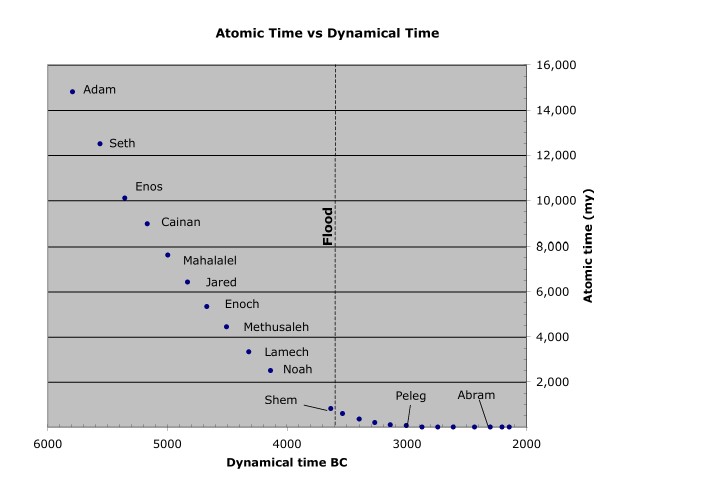
For many years I have followed, and worked closely with, Australian astronomer Barry Setterfield. Barry's main focus has been to show that the speed of light (c) is not a fixed constant over time but has dropped since creation. My colleague Canadian Statistician Alan Montgomery and I have worked together on the available measurements of various atomic constants.
Alan and I and confirmed in published papers that the speed of light has dropped in the last 300 years. A decreasing speed of light would mean that the radiometric (atomic) clock has slowed down with respect to dynamical time by a factor of 10 or 11 orders of magnitude.
See the Barry Setterfield Research Library for full details. Barry's recent work would indicate that Adam lived about 6000 BC and the Flood of Noah occurred about 3500 BC.
Most creation scientists believe there is indeed an appearance of age in the universe. For instance when we first meet newly-created Adam in the Garden of Eden it is generally assumed he was a fully grown man, that he had no navel, and the trees of the Garden were mature trees and not mere sprouts. There are corresponding atomic and dynamic time scales for the standard geological column.
1. I know very little about number things in the OT, and what I do know is decreasing (e.g., I am losing confidence that all/many/most of them were MEANT by the author to be taken as real 'numbers'...some cases seem to be obvious symbolic values, semi-puns, pedagogical devices, memory aids, etc.).
2. Genealogies are especially problematic, IMO, since the numbers in them had ZERO importance to their social function (i.e., to situate an individual in an social context)--numbers meant/contributed NOTHING to this task, and are accordingly 'window dressing' and/or a way to indicate SOME THING ELSE. What this 'something else' is, in an ancient context, both variable and unclear to me.
3. The LXX "bails us out" several times in OT numerical problems/contradictions, so, as a source it has a high--but uneven--credibility with me for such things.
4. I haven't studied this, but if I had to, the approach I would START WITH would be to build a comparative table of four (maybe five or six) columns, with one row for each number in Gen 1-11 (not just genealogy numbers--patterns in other numbers might reveal some pattern of number 'meaning' or literary usage).
The rows would consist of the numbers in the different versions:
(1) The MT (obviously, but you would need to check the Text Apparatus for juicy variants),
(3) The Dead Sea Scrolls (representing our OLDEST real mss of the Hebrew bible, of course. I would start with the work by Abegg, Flint, Ulrich --"The Dead Sea Scrolls Bible", and if one of the numbers they give look juicy, you could drill down);
(4) the Peshitta (of possible value),
(5) the Targums (late, but still BEFORE the MT in many cases); and
(6) parallels from the OT Pseudepigrapha and Apoc.: the category/genre known as "Retold Bible" are paraphrases/expansions of the early narratives (esp. Patriarchal), so you might find some interesting stuff in there. Since many/most of these are pre-MT (and some anti-MT...smile), they might could be of importance to your quest. [You could also check the rabbinics--Ginzberg's Legends of the Jews probably has all the alternate dates/ages/lengths listed in his work...there might be some variants in there.]
That's all I can suggest, since the next step would depend upon what patterns were detectable in the columns, of course...but it would be a fascinating subject!
I certainly can not prove to anyone that the universe is young. Had I lived in the 18th Century I believe most everyone around me (in the Western world) would readily agree with my young-earth hypothesis. It was taken for granted back then and seldom challenged.
Regarding the true age of things, I believe Scripture suggests this may be one of the areas where we may never really know for sure. Ecclesiastes 3:11 says this,
"...[God] has put eternity into the hearts of men, yet so that no man can find out what God has done from the beginning to the end."
I take this to suggest that the past is obscured in mists and uncertainty--as is the future--so we can not resolve with certainty the true age of things nor the detailed history of the universe. If we could time travel from the present into the past we would encounter several discontinuities where God has interfered with the status quo and altered man's future course and destiny. The passage in Ecclesiastes is similar to the New Testament claim that we can not set dates for future dates which are predicted to occur.
"So when they [the disciples] had come together, they asked him, 'Lord, will you at this time restore the kingdom to Israel?' Jesus said to them, 'It is not for you to know times (chronos) or seasons (kairos) which the Father has fixed by his own authority.'" (Acts 1:6-7)
The Bible is clear in telling us that the actual history of the universe has not been "uniformitarian." (2 Peter 3:3ff)
First of all you must understand this, that scoffers will come in the last days with scoffing, following their own passions and saying, "Where is the promise of his coming? Forever since the fathers fell asleep, all things have continued as they were from the beginning of creation." They deliberately ignore this fact, that by the word of God heavens existed long ago, and an earth formed out of water and by means of water, through which the world that then existed was deluged with water and perished. But by the same word the heavens and earth that now exist have been stored up for fire, being kept until the day of judgment and destruction of ungodly men. But do not ignore this one fact, beloved, that with the Lord one day is as a thousand years, and a thousand years as one day.
The Lord is not slow about his promise as some count slowness, but is forbearing toward you, not wishing that any should perish, but that all should reach repentance. But the day of the Lord will come like a thief, and then the heavens will pass away with a loud noise, and the elements will be dissolved with fire, and the earth and the works that are upon it will be burned up. Since all these things are thus to be dissolved, what sort of persons ought you to be in lives of holiness and godliness, waiting for and hastening the coming of the day of God, because of which the heavens will be kindled and dissolved, and the elements will melt with fire! But according to his promise we wait for new heavens and a new earth in which righteousness dwells.
Therefore, beloved, since you wait for these, be zealous to be found by him without spot or blemish, and at peace. And count the forbearance of our Lord as salvation. So also our beloved brother Paul wrote to you according to the wisdom given him, speaking of this as he does in all his letters. There are some things in them hard to understand, which the ignorant and unstable twist to their own destruction, as they do the other scriptures.
You therefore, beloved, knowing this beforehand, beware lest you be carried away with the error of lawless men and lose your own stability. But grow in the grace and knowledge of our Lord and Savior Jesus Christ. To him be the glory both now and to the day of eternity. Amen.
I was not present at the time of creation, none of my friends were. The scientific theories I have studied regarding the origin of the universe are surely only crude models. And they are built on the dubious assumptions that one can take 50 or 100 years of observations, compile the data and draw a curve extending backwards in time to t = 0. The Bible teaches me to be highly suspicious of any such simplistic models.
The Apostle Peter's warning seems quite clear to me in this regard.
Though I personally assume the universe is young, and though I naturally look for evidence that this is really so, the age of the universe is not a major plank in my platform of beliefs.
I know that the gospel is primarily an appeal to the conscience. Knowing God is a moral issue above all else (and all men are without excuse). Apologetics, such as we Christians try to do, should indeed be done with the highest possible integrity and openness. We Christians represent the Most High God by all we do and say and are. The fact that God has chosen the foolish things of this world to confound the wise does not give us the right to be stupid and ill-informed, not doing our homework, nor ignoring our critics.
If individuals can be deceived and misled in this world--and I was once a prime example--then I have no problem with groups of well-intentioned scientists being wrong sometimes, or even often. I have lived long enough to have seen all sorts of once-popular scientific ideas give way to the newer and better.
The statement "It is the glory of God to conceal things, the glory of kings is to search them out" tells me God values and rewards our search and discovery processes. Our hard questions are welcome in His courts.
Astronomer Allan Sandage said this, "Science is the only self-correcting human institution, but it is also a process that progresses only by showing itself to be wrong."
Comments on the Age of the Universe, (from a colleague)
Question:
Doesn't scientific evidence show that the earth is much more than only 6000 years old?
Answer:
There is no scientific measurement of the earth's age whatsoever. That is because there was no clock starting at the beginning and continuing to the present. Instead, dating consists of "extrapolating" present-day processes of various sorts back into time assuming the processes have not changed in rate. But there is abundant evidence of changes in rate of radioactive decay and other processes (e.g., radiohalos).
The current estimates of about 4.7 billion years for the age of the earth were not arrived at by objective research with no thought of Darwinian evolution. They were found by predetermined notions that the age should be in the billions of years in order to allow sufficient time for evolution--in other words "objective" radiometric dating was designed specifically to help Darwin's theory.
A government scientist rejected scientific creationism and a young earth model with the following comments: So why does science now believe the age of the universe to be much older than some Christians propose? It is because the evidence overwhelmingly demands it. 'tis not something someone dreamed up and then looked for the evidence to support it.'
But that is exactly what evolutionists did in the late 19th century: They deliberately 'dreamed up' the idea that the earth must be from hundreds of millions to billions of years old and then went in search of evidence to support it.
Charles Darwin decided in the first edition of Origin of Species that he needed 'far longer' than 300,000,000 years of earth history in the Cenozoic era alone for his theory of evolution to work though he never explained why evolution needed that specific amount of time (and even today no more than about 65 million years is allowed for the Cenozoic era) - so there's your 'something someone dreamed up.' Lord Kelvin initially gave him less than a hundred million years, but his later estimates dropped still further and allied calculations such as Peter Tait's came down as low as several million years, thus creating what has sometimes been called Darwin's greatest crisis.
Darwin struggled for decades (from Kelvin's first direct challenge in 1865 until Darwin's death in 1882) trying to get around this problem. Darwin and his supporters enlisted help from every quarter - geologists, physicists, biologists, engineers, mathematicians, etc. - to try to refute Kelvin. It even made 'bulldog' Thomas Huxley, Darwin's staunchest defender, 'squirm,' says renowned evolution historian Loren Eiseley.
Loren Eiseley, Darwin's Century (Anchor Books/Doubleday, Garden City, N.Y., 1961 [1958]) pp. 233-253, esp. p. 237 quoting Charles Darwin, The Origin of Species (John Murray, London, 1859 [Philosophical Library, New York, 1951 reprint] p. 245. Eiseley wrote that there had been few if any scientific attempts to date the earth prior to Kelvin and that until then geologic time was considered vague and 'unlimited,' thus allowing whatever Darwin needed for his theory:
'...within six years after the [1859] publication of that work [The Origin of Species] an attack on the conception of unlimited geological time had been launched with such vigor that, by the end of the century, it was still one of two leading arguments entertained by many naturalists as casting doubt upon the principle of natural selection.
It had SHAKEN THE CONFIDENCE OF DARWIN himself, forced Huxley into a defense characterized more by SOPHISTRY than scientific objectivity, and placed geology in general in the position of an errant schoolboy before his masters. The attack had been launched by Lord Kelvin, contended by many historians of science to be the outstanding physicist of the nineteenth century...'It can be observed from Darwin's letters that this development in physics gravely troubled him.
He refers to Lord Kelvin as an 'odious spectre,' and in a letter [of 1869] ...he writes: 'Notwithstanding your excellent remarks on the work which can be effected within a million years, I am GREATLY TROUBLED at the short duration of the world according to Sir W. Thomson [Lord Kelvin] for I require for my theoretical views a very long period before the Cambrian formation.' ...Painfully and doubtfully he [Darwin] wrote to Wallace in 1871, 'I have not as yet been able to digest the fundamental notion of the shortened age of the sun and earth.'(Eiseley, supra, pp. 234, 235, 240, my capitals added.)
Evolutionary geneticist Hugo De Vries wrote in Science in 1904 that Kelvin's age calculations 'threatened to impair the whole theory of descent' because gradual EVOLUTION REQUIRED 'many thousands of millions of years [= MANY BILLIONS OF YEARS].' (Science, N.S. 20:398, quoted in Eiseley, supra, p. 248.)
Science historian Albritton writes of some of the desperate efforts about 1865-1900 to get around Kelvin's limit. As Kelvin kept reducing his estimates the reactions of the scientific community 'ranged from meek accommodation to RESOLUTE OPPOSITION. Alternate SCHEMES of measuring time past were DEVISED, and the figures resulting from these EXERCISES IN ARITHMETIC ranged between 10 million and 15 trillion years.' (Claude C. Albritton, Jr., The Abyss of Time Freeman, Cooper & Co., San Francisco, 1980) p. 203, my capitals added.)
Why would there have been "RESOLUTE OPPOSITION" to simple reductions of a number, the number representing the age of the earth, if it was all merely an objective and dispassionate "search for the truth"?
The reality was that scholars made every effort to try to give the evolutionists what they wanted in the way of large amounts of geologic time. This was favoritism and bias towards Darwin. As with Darwin and those evolutionists cited by De Vries, this typically amounted to the order of magnitude of BILLIONS OF YEARS.
One author estimated the age of the earth from sedimentation rates for geologic strata as somewhere between 10 million and 5 trillion years, with a rough logarithmic mean of 6 BILLION YEARS. (William J. McGee, Science (1893) 21:309-310, cited in Albritton, supra, pp. 192-193.)
Another author critiquing Kelvin's work said 'If PALEONTOLOGISTS have good reasons for demanding much greater times [than 400 million to 1 billion years] I see nothing from the physicists' point of view which denies them four times the greatest of these estimates' - in other words 4 BILLION YEARS. (John Perry, Nature (1895) 51:582-585 at p. 585, quoted in Albritton, supra, p. 195.)
Hence, there was a lot of effort in the 1865-1905 period to find evidence to support figures for the earth's age in the BILLION-YEAR range in order to aid the evolutionists' guesswork. Eiseley comments that 'A collected bibliography of the subject through the period 1862 to 1902 would be enormous.' Albritton remarks that these were not really scientifically sound estimates, 'Given the prevailing uncertainties ...one could arrive at almost any preconceived magnitude of time.' (Albritton, supra, pp. 186, 192, my capitals.)
These pioneer geochronologists knew approximately what time frame to expect in order to satisfy the evolutionists and not surprisingly they eventually found it. As early as 1878, a scheme was worked out in which the basic geologic time scale approximating our Paleozoic-Mesozoic-Cenozoic eras would occupy about 600 million years - exactly the modern day figure to one-digit precision but long before radioactivity had even been discovered. (T. Mellard Reade, 'Limestone as an Index of Geological Time,' Proceedings of the Royal Society (1878) 28:281.)
Some like to suggest that the scientists who developed radiometric dating had no idea they were going to find an Old Earth, that they had no interest in the evolution controversy, that they simply reported the facts as they found them, unaware of the implications until after making the discovery.
But history says differently. Once Curie and Laborde discovered in 1903 that radioactivity gave off heat, this immediately led Rutherford to suggest in 1904 that radioactivity could now refute Kelvin's overly restrictive age of the earth, which had been based on the projected cooling rate of the planet from a hot molten state. Rutherford wrote:
'...the temperature gradient observed in the earth may be due to the heat liberated by the radioactive matter...If this be the case...Lord Kelvin's computation may only supply the minimum limit to the age of this planet...The discovery of the RADIOACTIVE elements, which in their disintegration liberate enormous amounts of energy, thus increases the possible limit of the duration of life on this planet, and ALLOWS THE TIME CLAIMED by the geologist and biologist for the process of EVOLUTION.' (Ernest Rutherford, 'The Radiation and Emanation of Radium' part 2, Technics (August 1904) pp. 171-175, reprinted in The Collected Works of Lord Rutherford of Nelson (Allen & Unwin, London, 1962) vol. 1, p. 657, quoted in Albritton, supra, p. 203, my capitals added.)
Here we have a clear statement of interest by Rutherford in finding evidence to support the evolutionary time scale by use of radiometric dating -- at the very inception of the concept by its inventor, Rutherford. Shortly thereafter (1905), Bertram Boltwood and John Strutt (Lord Rayleigh) took up Rutherford's idea and made the first attempts to radiometrically date rock specimens. (Albritton, p. 204)
Question: Doesn't the fossil record indicate change over time? Why aren't there human fossils in all the strata?
Answer: The fossil record does NOT show the millions of fine intergradations between major categories of organisms that Darwin and his successors expected. That is why "punctuated equilibrium" theories were developed in recent decades to explain away the massive gaps in the fossil record.
Human fossils and manufactured artifacts ARE found in various geologic strata but they are relatively rare due to difficulty in finding them in the massive sediments constituting the "geologic record" since the Cambrian layer and due to the destructive effects of catastrophic sedimentation. (See Forbidden Archeology by Michael Cremo and Richard Thompson, a massively documented 1,000-page book researched by NON-Christian Hindus and devoted to compiling evidence of human remains and artifacts in geologic strata.)
It is also likely that humans were better able than animals to avoid sudden catastrophic burial in sediment by fleeing to higher ground. Also, there may have been localized less sediment burials with the world's human population concentrated mainly in the Middle East where flood conditions may have been less severe than elsewhere (as witness the survival of Noah's Ark)."